Mayor Federico Gutiérrez Zuluaga presented a report on the city’s capabilities in disaster management, response, and risk reduction during the official opening of the International Meeting of Resilience Hubs, which brings together national and international representatives and experts on September 17 and 18. Medellín was chosen to host the event because of its leadership in mitigating the consequences of climate-related events, with a focus on protecting people’s lives.
The city was chosen to host the international meeting on disaster risk management actions. Kamal Kishore, a United Nations special representative, learned about the District’s established capacity in this area.
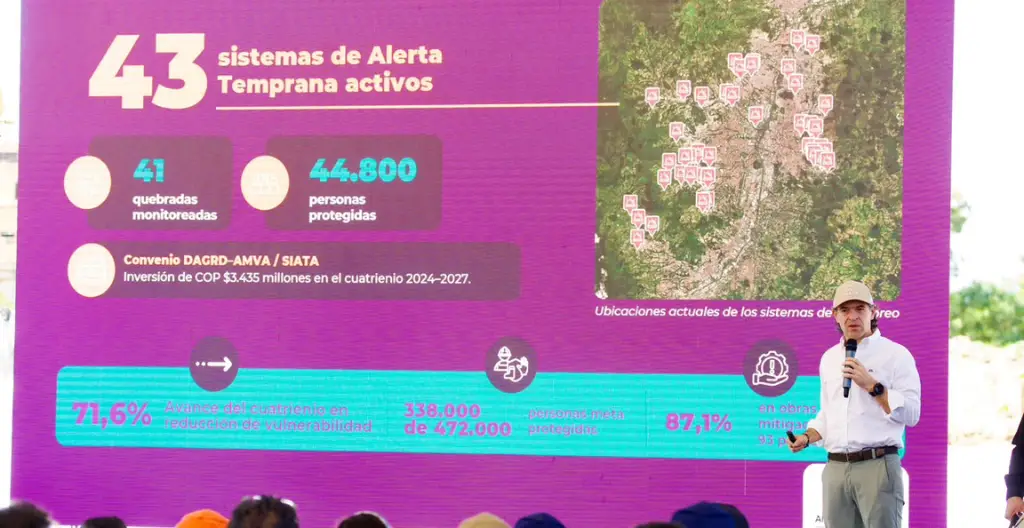
The city’s achievements are evident in aspects such as the 43 early warning systems that monitor 41 streams and protect more than 44,800 people, thanks to coordinated efforts with the DAGRD, the Aburrá Valley Metropolitan Area, and its Siata project, for which the District has invested $3,435 million during the 2024–2027 term. In vulnerability management, progress stands at 71.61%, with 338,000 people protected, and at 87.10% for mitigation projects. Additionally, more than 5,250 emergencies were responded to in 2026, of which 172 were wildfires. Of these cases, more than 70 occurred in August and September.
These actions underpin the recognition by the United Nations Office for Disaster Risk Reduction (UNDRR), which also highlights Medellín as one of five cities in Colombia—along with Bogotá, Cali, Manizales, and Dosquebradas—and one of 44 worldwide that make up the Resilience Hubs for climate action. Kamal Kishore, Special Representative of the UN Secretary-General for Disaster Risk Reduction and Director of UNDRR, is participating in the visit and attended one of its main activities: a tour of the construction site at Parque Primavera Norte.
Medellín combines innovation, technology, urban planning, and climate action, such as 43 early warning systems that monitor 41 streams.
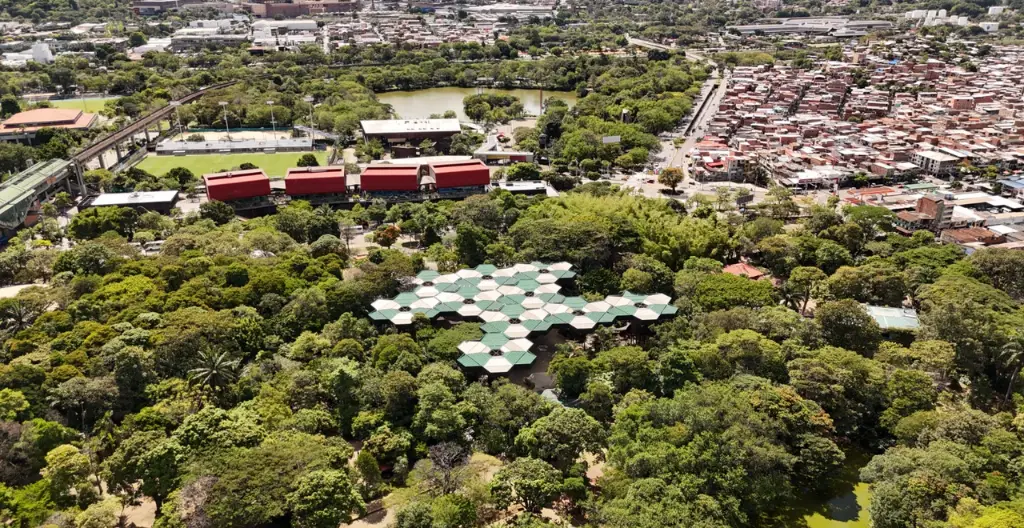
“We are surrounded by mountains, and a large part of our community is settled on slopes in high-risk areas. This is an ongoing issue of risk management, but we have prepared ourselves for it. More than just a public space, this is a park designed for well-being, to prevent and mitigate risk, and to improve people’s quality of life. This park in particular is an example of that, thanks to the sustainable urban drainage systems (SUDS) that have already been installed beneath the sports field and at other key locations,” said the mayor.
The mayor noted that SUDS are an innovative engineering solution that mitigates flood risk through waterproof underground tanks (geocells). This “sponge city” technology captures water through specialized channels and ditches, then directs it to a filtration network before storing it in a tank sized to regulate runoff flow; subsequently, that water is released in a controlled manner into the Medellín River or local streams. The technology is being implemented in two strategic projects: Primavera Norte and Gran Parque Medellín.
Additionally, the District has its own public technology platform, SIRMED, which integrates hazard and risk maps, real-time monitoring, mitigation projects, and educational materials; it also includes the Kraken project, which provides advanced analytics and mass movement modeling, with instruments installed in the most vulnerable neighborhoods and townships. And the DAGRD Toolkit, which shares knowledge with other cities, integrates risk analysis, building damage assessment, and technical field inspections. This capacity was put to the test during the August 10 earthquake, when Medellín deployed technical commissions comprising 95 engineers—including 7 foreign professionals—to assist with damage assessments in Armenia, Pereira, Cali, Manizales, Quimbaya, Calarcá, La Tebaida, and Montenegro.
“Knowledge transfer is one of the biggest challenges. Cities have resources, but these must be applied to implement practices that already work in other cities. It’s not just about inventing new things; it’s about looking at what works elsewhere and what can be adapted. For us, it’s very important to continue positioning the city as a national and international leader in risk management,” the mayor emphasized.
Ver esta publicación en Instagram